Circuit diagram:
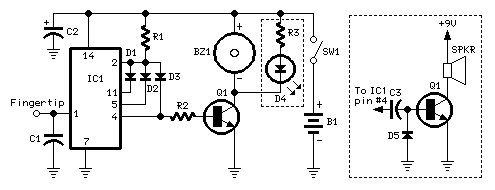
Parts:
R1______________10K  1/4W Resistor
R2_______________4K7 1/4W Resistor
R3_____________100R  1/4W Resistor (Optional, see Notes)

C1_______________1nF  63V Polyester or ceramic Capacitor
C2______________10µF  25V Electrolytic Capacitor
C3_____________100nF  63V Polyester or ceramic Capacitor (Optional, see Notes)

D1,D2,D3_____1N4148   75V 150mA Diodes
D4______________LED   (Optional, any shape and color, see Notes)
D5___________1N4148   75V 150mA Diode (Optional, see Notes)

Q1____________BC337   45V 800mA NPN Transistor

IC1____________4024   7 stage ripple counter IC

BZ1___________Piezo sounder (incorporating 3KHz oscillator)

SPKR______________8 Ohm, 40 - 50mm diameter Loudspeaker (Optional, see Notes)

SW1____________SPST Toggle or Slide Switch (Optional, see Notes)

B1________________3 to 12V Battery (See Notes)
Comments:
This accurate one-pulse-per-second clock is made with a few common parts and driven from a 50 or 60 Hertz mains supply but with no direct connection to it.
A beep or metronome-like click and/or a visible flash, will beat the one-second time and can be useful in many applications in which some sort of time-delay counting in seconds is desirable.
The circuit is formed by a CMos 4024 counter/divider chip and 3 diodes, arranged to divide the frequency of the input signal at pin #1 by 50 (or 60, see Notes).
The input impedance at pin #1 is very hight, so simply touching the pin (or a short track or piece of wire connected to it) is usually enough to provide the necessary input signal.
Another way to provide an input signal consists in a piece of wire wrapped several times around any convenient mains cable or transformer. No other connection is necessary.
Notes:
- To allow precise circuit operation in places where the mains supply frequency is rated at 60Hz, the circuit must be modified as follows: disconnect the Cathode of D1 from pin #11 of IC1 and connect it to pin #9. Add a further 1N4148 diode, connecting its Anode to R1 and the Cathode to pin #6 of IC1: that's all!
- The circuit will work fine with battery voltages in the 3 -12V range.
- The visual display, formed by D4 and R3 is optional. Please note that R3 value shown in the Parts list is suited to low battery voltages. If 9V or higher voltages are used, change its value to 1K.
- If a metronome-like click is needed, R2 and BZ1 must be omitted and substituted by the circuit shown enclosed in dashed lines, right-side of the diagram.
- Stand-by current drawing is negligible, so SW1 can be omitted.