Circuit diagram:
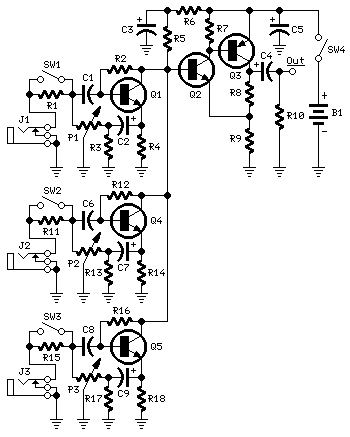
Parts:
P1,P2,P3_________5K  Linear Potentiometers

R1,R11,R15_____180K  1/4W Resistors
R2,R12,R16_______2M2 1/4W Resistors
R3,R13,R17_____750R  1/4W Resistors (See Notes)
R4,R14,R18_______1K  1/4W Resistors
R5______________15K  1/4W Resistor
R6_____________220R  1/4W Resistor
R7_______________1K5 1/4W Resistor
R8_____________820R  1/4W Resistor
R9_____________150R  1/4W Resistor
R10____________100K  1/4W Resistor

C1,C6,C8_________1µF  63V Polyester or Electrolytic Capacitors
C2,C4,C7,C9____100µF  25V Electrolytic Capacitors
C3,C5__________220µF  25V Electrolytic Capacitors

Q1,Q4,Q5______BC550C  45V 100mA Low noise High gain NPN Transistors
Q2____________BC547   45V 100mA General purpose NPN Transistor
Q3____________BC557   45V 100mA General purpose PNP Transistor

J1,J2,J3________3mm or 6mm Mono Jack sockets

SW1,2,3,4______SPST  Toggle or Slider Switches

B1_______________9V  PP3 Battery

Clip for PP3 Battery
Comments:
Although the modular Portable Mixer design available on these web pages has become a hit for many amateurs, some correspondents required a much simpler device, mainly for mixing mono signals.
This design should fulfil their needs, featuring three inputs with switchable high/low sensitivity and unusual level-control circuits, providing high overload margins and low-noise figures, proportional to gain-level settings.
Low current consumption due to a simple, five-transistor circuitry, allows the Mini Mixer to be powered by a common 9V PP3 battery for many hours.
Notes:
- When SW1, SW2 or SW3 are open the input sensitivity is suited to high-output devices like CD players, tuners, tape recorders, iPods, miniDisc players, computer audio outputs etc.
- When SW1, SW2 or SW3 are closed the input sensitivity is suited to low-output, low-impedance moving coil or electret microphones.
- Sometimes, the 750 Ohm value for R3, R13 and R17 resistors could be not easy to find. In this case, two 1K5 resistors wired in parallel can be used to replace each item.
- To make a stereo mixer, all the parts must be doubled excepting R6, C3, C5, SW4 and B1.
Technical data (Level controls in mid position)
Sensitivity:
- Low level inputs:
- 2mV RMS for 316mV RMS output [-10dB(V)]
- 6mV RMS for 0.775V RMS output [0dB(V)]
- High level inputs:
- 130mV RMS for 316mV RMS output [-10dB(V)]
- 400mV RMS for 0.775V RMS output [0dB(V)]
Maximum Input sensitivity: 1.3mV RMS for 0.775V RMS output [0dB(V)]
Maximum undistorted output: 2.4V RMS [+10dB(V)]
Frequency response: flat from 20Hz to 20KHz
Total harmonic distortion @ 1KHz: <0.1% @ -10dB(V); <0.3% @ 0dB(V)
Total harmonic distortion @10KHz: <0.08% @ -10dB(V); <0.24% @ 0dB(V)
Current drawing: 7mA @ 9V supply