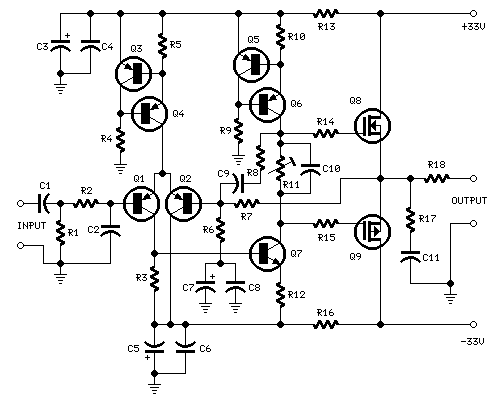
Circuit diagram:
Parts:

R1,R4_________47K  1/4W Resistors
R2____________4K7  1/4W Resistor
R3____________1K5  1/4W Resistor
R5__________390R   1/4W Resistor
R6__________470R   1/4W Resistor
R7___________33K   1/4W Resistor
R8__________150K   1/4W Resistor
R9___________15K   1/4W Resistor
R10__________27R   1/4W Resistor
R11_________500R   1/2W Trimmer Cermet
R12,R13,R16__10R   1/4W Resistors
R14,R15_____220R   1/4W Resistors
R17___________8R2    2W Resistor
R18____________R22   4W Resistor (wirewound)

C1___________470nF  63V Polyester Capacitor
C2___________330pF  63V Polystyrene Capacitor
C3,C5________470µF  63V Electrolytic Capacitors
C4,C6,C8,C11_100nF  63V Polyester Capacitors
C7___________100µF  25V Electrolytic Capacitor
C9____________10pF  63V Polystyrene Capacitor
C10____________1µF  63V Polyester Capacitor

Q1-Q5______BC560C   45V 100mA Low noise High gain PNP Transistors
Q6_________BD140    80V 1.5A PNP Transistor
Q7_________BD139    80V 1.5A NPN Transistor
Q8_________IRF530  100V 14A N-Channel Hexfet Transistor
Q9_________IRF9530 100V 12A P-Channel Hexfet Transistor
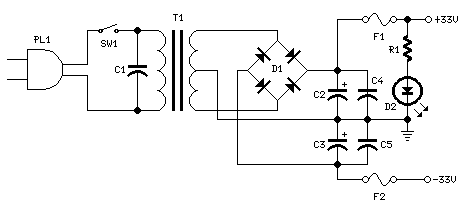
Power supply circuit diagram:
Parts:
R1____________3K3  1/2W Resistor

C1___________10nF 1000V Polyester Capacitor
C2,C3______4700µF   50V Electrolytic Capacitors
C4,C5_______100nF   63V Polyester Capacitors

D1__________200V 8A Diode bridge
D2__________5mm. Red LED

F1,F2_______3.15A Fuses with sockets

T1__________220V Primary, 25 + 25V Secondary 120VA Mains transformer

PL1_________Male Mains plug

SW1_________SPST Mains switch
Notes:
- Can be directly connected to CD players, tuners and tape recorders. Simply add a 10K Log potentiometer (dual gang for stereo) and a switch to cope with the various sources you need.
- Q6 & Q7 must have a small U-shaped heatsink.
- Q8 & Q9 must be mounted on heatsink.
- Adjust R11 to set quiescent current at 100mA (best measured with an Avo-meter connected in series to Q8 Drain) with no input signal.
- A correct grounding is very important to eliminate hum and ground loops. Connect to the same point the ground sides of R1, R4, R9, C3 to C8. Connect C11 to output ground. Then connect separately the input and output grounds to power supply ground.
- An earlier prototype of this amplifier was recently inspected and tested again after 15 years of use. Results, comments and pictures are shown here.
Technical data:
- Output power:
- well in excess of 25 Watt RMS @ 8 Ohm (1KHz sine wave)
- Sensitivity:
- 200mV input for 25W output
- Frequency response:
- 30Hz to 20KHz -1dB
- Total harmonic distortion @ 1KHz:
- 0.1W 0.014% 1W 0.006% 10W 0.006% 20W 0.007% 25W 0.01%
- Total harmonic distortion @10KHz:
- 0.1W 0.024% 1W 0.016% 10W 0.02% 20W 0.045% 25W 0.07%
- Unconditionally stable on capacitive loads