Circuit diagram:
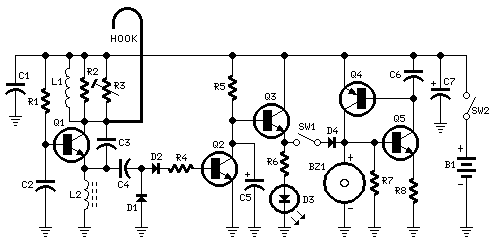
Parts:
R1______________1M   1/4W Resistor
R2______________3K3  1 or 2W Resistor (See Notes)
R3_____________10K   1/2W Trimmer Cermet (See Notes)
R4_____________33K   1/4W Resistor
R5____________150K   1/4W Resistor
R6______________2K2  1/4W Resistor
R7_____________22K   1/4W Resistor
R8______________4K7  1/4W Resistor

C1,C2__________10nF   63V Ceramic or Polyester Capacitors
C3_____________10pF   63V Ceramic Capacitor
C4,C6_________100nF   63V Ceramic or Polyester Capacitors
C5______________2µ2   25V Electrolytic Capacitor
C7____________100µF   25V Electrolytic Capacitor

D1,D2,D4_____1N4148   75V 150mA Diodes
D3_____________5 or 3mm. Red LED

Q1,Q2,Q3,Q5___BC547   45V 100mA NPN Transistors
Q4____________BC557   45V 100mA PNP Transistor

L1_________________   (See Notes)
L2_____________10mH  miniature Inductor

Hook_______________   (See Notes)

BZ1___________Piezo sounder (incorporating 3KHz oscillator)

SW1,SW2________SPST  miniature Slider Switches

B1_______________9V  PP3 Battery

Clip for PP3 Battery
Device purpose:
This circuit emits a beep and/or illuminates a LED when someone touches the door-handle from the outside. The alarm will sound until the circuit will be switched-off.
The entire circuit is enclosed in a small plastic or wooden box and should be hanged-up to the door-handle by means of a thick wire hook protruding from the top of the case.
A wide-range sensitivity control allows the use of the Door Alarm over a wide variety of door types, handles and locks. The device has proven reliable even when part of the lock comes in contact with the wall (bricks, stones, reinforced concrete), but does not work with all-metal doors.
The LED is very useful during setup.
Circuit operation:
Q1 forms a free-running oscillator: its output bursts drive Q2 into saturation, so Q3 and the LED are off. When part of a human body comes in contact with a metal handle electrically connected to the wire hook, the body capacitance damps Q1 oscillations, Q2 biasing falls off and the transistor becomes non conducting. Therefore, current can flow into Q3 base and D3 illuminates. If SW1 is closed, a self-latching circuit formed by Q4 & Q5 is triggered and the beeper BZ1 is activated.
When the human body part leaves the handle, the LED switches-off but the beeper continues to sound, due to the self-latching behavior of Q4 & Q5. To stop the beeper action, the entire circuit must be switched-off opening SW2.
R3 is the sensitivity control, allowing to cope with a wide variety of door types, handles and locks.
Notes:
- L1 is formed winding 20 to 30 turns of 0.4mm. diameter enameled copper wire on R2 body and soldering the coil ends to the resistor leads. You should fill R2 body completely with coil winding: the final turns' number can vary slightly, depending on different 1 or 2W resistor types actual length (mean dimensions for these components are 13 - 18mm. length and 5 - 6mm. diameter).
- The hook is made from non-insulated wire 1 - 2mm. diameter (brass is well suited). Its length can vary from about 5 to 10cm. (not critical).
- If the device is moved frequently to different doors, Trimmer R3 can be substituted by a common linear potentiometer fitted with outer knob for easy setup.
- To setup the device hang-up the hook to the door-handle (with the door closed), open SW1 and switch-on the circuit. Adjust R3 until the LED illuminates, then turn slowly backwards the screwdriver (or the knob) until the LED is completely off. At this point, touching the door-handle with your hand the LED should illuminate, going off when the hand is withdrawn. Finally, close SW1 and the beeper will sound when the door-handle will be touched again, but will not stop until SW2 is opened.
- In regular use, it is advisable to hang-up and power-on the device with SW1 open: when all is well settled, SW1 can be closed. This precautionary measure is necessary to avoid unwanted triggering of the beeper.